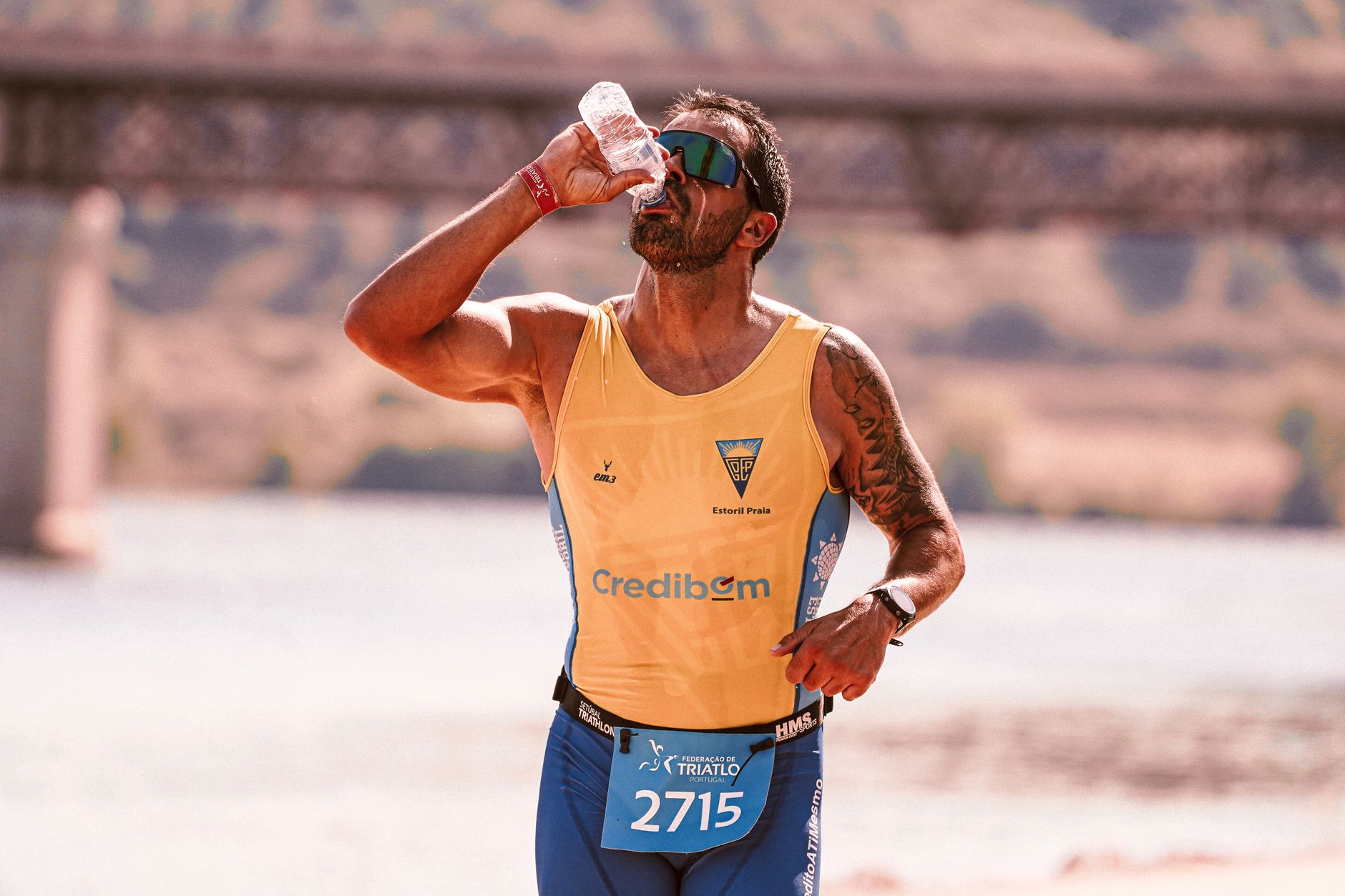
Why does triathlon hydration demand leg-specific protocols instead of a single fueling plan?
Triathlon hydration cannot follow a one-size-fits-all fueling plan because each leg—swim, bike, run—imposes radically different physiological constraints on fluid absorption and core temperature regulation. During the swim, horizontal body position and water immersion limit gastric emptying to near zero, making any intake a liability for slosh and nausea. The bike leg offers the highest absorption window, with trained athletes processing up to 1,200 mL per hour in the aero position as gut blood flow remains stable. The run leg cuts absorption capacity by 40-60% under mechanical impact, forcing athletes to ration carefully and rely on fluid banked during the bike. Research by Rehrer (1990) and Peters (1995) confirms that gastric emptying rates vary by posture and exercise modality, meaning triathletes who drink the same volume across all three legs either under-hydrate on the bike or over-drink on the run, both of which cost time and increase GI distress risk.
| Leg | Absorption Capacity (mL/hour) | Sweat Rate (L/hour) | Core Temp Rise (°C) | |———|———————————–|————————-|————————-| | Swim | ~0-200 | ~0.3-0.6 | +0.3-0.5 | | Bike | 800-1,200 | ~0.8-1.2 | +0.8-1.2 | | Run | 300-600 | ~1.0-1.5 | +1.0-1.8 |
How horizontal swim position and water immersion affect fluid absorption
Lying prone in the water compresses the stomach against the diaphragm and redistributes blood flow toward the core and working muscles, leaving minimal capacity for gastric emptying. Water immersion also triggers a mild diuresis—your body perceives the hydrostatic pressure as fluid overload and signals the kidneys to shed volume. Any fluid consumed during the swim sits in the stomach rather than moving to the intestines for absorption, creating the conditions for nausea, aspiration risk, and wasted energy managing gastric discomfort. For these reasons, Olympic-distance swimmers should drink nothing during the 20-40 minute swim, and even Ironman swimmers benefit from skipping in-water intake except for a single sip at a distant buoy if conditions allow.
Why the bike leg offers the highest electrolyte absorption window
The bike is where triathletes should aggressively bank fluid and sodium. The aero position stabilizes the torso, reduces mechanical jostling of the gut, and maintains steady blood flow to the intestines—conditions that allow absorption rates of 800-1,200 mL per hour in trained athletes. Core temperature rises more gradually on the bike than on the run, giving the gut time to process incoming volume before heat stress begins redirecting blood away from digestion. Triathletes who treat the bike as a passive coast rather than a banking opportunity arrive at T2 already behind on hydration, forcing them to play catch-up during the run when absorption capacity has dropped by half. This is the leg to over-drink slightly relative to perceived thirst, especially in the first 60 minutes when gastric emptying is most efficient.
How mechanical impact on the run reduces gastric emptying by up to 60%
Every footstrike sends a shockwave through the gut, disrupting peristalsis and reducing intestinal blood flow as the body prioritizes oxygen delivery to working leg muscles. Research shows that running at race pace can cut gastric emptying rates by 40-60% compared to cycling at the same heart rate, meaning the stomach empties slower and the small intestine absorbs less of what does pass through. Add rising core temperature—which further diverts blood from the gut to the skin for cooling—and you have a system that simply cannot process the same 800 mL per hour it handled on the bike. Triathletes who ignore this physiological reality and continue aggressive drinking on the run end up with fluid sloshing in the stomach, cramping, and in severe cases, hyponatremia from diluting already-depleted sodium stores with plain water. The run is about rationing what you banked, not replacing what you’re losing in real time.
What should triathletes drink before and during the swim leg?
Pre-swim hydration should focus on sodium pre-loading and topping off fluid stores in the 90-120 minutes before the race start, then tapering to minimal sips in the final 20 minutes to avoid bathroom emergencies on the beach. Consume 400-600 mL of fluid with 500-1,000 mg of sodium (for half and full Ironman distances) approximately 60-90 minutes before your wave goes off—Fast Pickle delivers 120 mg sodium per ounce in a natural, fast-absorbing pickle brine, making 3-4 ounces an efficient pre-load tool without the gastric volume of a full electrolyte drink. During the swim itself, most age-group triathletes should drink nothing—horizontal position, wetsuit compression, and the risk of aspiration make any intake more costly than beneficial. For half and full Ironman swims that stretch past 40 minutes, you may take 1-2 small sips at a far turn buoy if you’ve practiced the skill and conditions are calm, but skipping in-swim hydration entirely is the safer, faster protocol for the majority of athletes.
Pre-swim sodium loading: how much and when
Sodium pre-loading expands plasma volume and buffers early sweat losses, giving you a physiological head start before the race begins. For half and full Ironman distances, target 500-1,000 mg of sodium 60-90 minutes before the start. Fast Pickle (3-4 oz at 120 mg sodium per oz) delivers approximately 360-480 mg in a small, gut-friendly volume, while a single LMNT stick (1,000 mg sodium) mixed with 16 oz of water hits the upper end of that range. For Olympic distance, 300-500 mg is sufficient—you’ll be in the water less than 30 minutes and won’t accumulate the same deficit. Stop drinking anything but small sips 20 minutes before your wave start to allow your bladder to empty and avoid the panicked wetsuit peel in the porta-potty line.
Timing matters: consume sodium too early (2+ hours out) and you’ll urinate most of it before the gun; too late (final 15 minutes) and you’ll feel bloated or need an urgent bathroom stop mid-swim. The 60-90 minute window gives your kidneys time to retain the sodium, expand blood volume, and stabilize before you hit the water.
Why most triathletes should drink nothing during the swim
Drinking during the swim introduces three major risks with minimal upside. First, horizontal body position compresses the stomach and halts gastric emptying, so any fluid you consume sits there rather than absorbing—adding dead weight and slosh with no hydration benefit. Second, the mechanical challenge of drinking while treading water or rolling to breathe costs energy, breaks rhythm, and in choppy conditions can lead to aspiration or choking. Third, triathletes typically spend 20-40 minutes (Olympic) or 40-70 minutes (half/full) in the water—not enough time to accumulate meaningful dehydration that would justify the trade-offs. The research backs this up: studies show no performance benefit from in-swim hydration for efforts under 90 minutes, and most age-groupers finish the swim with less than 1% body weight loss. Save your energy, skip the bottle at the turn buoy, and focus on banking fluid the moment you’re on the bike.
What is the best hydration and electrolyte protocol for the bike leg?
The bike leg is your banking window—target 600-800 mL per hour for most age-group triathletes, with 500-700 mg of sodium per hour, and be prepared to push toward 1,000 mL per hour if you’re a faster athlete racing in heat. This is where you should intentionally over-hydrate slightly relative to thirst, because your gut is processing fluid at peak efficiency and you’ll need that banked volume to survive the run when absorption drops by half. Use a two-bottle setup: one with plain water, one with electrolytes, and alternate between them every 12-15 minutes using a watch timer rather than waiting for thirst cues. Start drinking 10-15 minutes into the bike—not immediately out of T1 when your heart rate is spiking—and maintain consistent intake throughout the leg. The aero position actually aids gastric emptying compared to upright posture, so use those aero bars and drink while staying low.
How much should you drink per hour on the bike?
Most age-group triathletes should aim for 600-800 mL per hour, which translates to roughly 150-200 mL (5-7 oz) every 15 minutes. Faster athletes with higher sweat rates or those racing in temperatures above 80°F may need to push toward 1,000 mL per hour. Measure your personal sweat rate during a race-simulation ride: weigh yourself before and after a 60-minute effort in race conditions, subtract any fluid consumed, and the difference is your hourly loss—most athletes land between 0.8-1.5 L per hour. You don’t need to replace 100% of that loss during the bike (full replacement is neither possible nor necessary), but you should aim for 60-80% replacement to avoid arriving at T2 in a deficit.
Set a timer and stick to the schedule. Thirst is a lagging indicator—by the time you feel thirsty, you’re already behind, and catching up on the run is a losing game.
Sodium banking strategy: why the bike is your electrolyte window
You lose sodium faster than you lose water—sweat concentrations range from 500-1,500 mg per liter depending on genetics, heat acclimatization, and intensity. If you replace fluid without replacing sodium, you dilute your blood sodium concentration and set the stage for hyponatremia, cramping, or both. The bike is where you bank sodium because your gut absorbs it efficiently alongside fluid, and you can carry higher-sodium drinks that would be intolerable during the mechanical stress of the run. Target 500-700 mg of sodium per hour on the bike. A 16 oz bottle of Skratch Hydration delivers 380 mg; LMNT delivers 1,000 mg per stick but may need dilution if you’re not a heavy sweater. Fast Pickle in a small flask on your aero bars (3-4 oz per hour) adds 360-480 mg of natural sodium and can be sipped independently of your bottles for flexible dosing.
Best electrolyte drinks for the bike leg ranked by sodium content
Here are proven bike-leg options ranked by sodium density:
- Fast Pickle — 120 mg sodium per oz, natural pickle brine, carry in a small flask and sip 3-4 oz per hour for 360-480 mg sodium with minimal gastric volume.
- LMNT — 1,000 mg sodium per stick, mix with 16-24 oz water; ideal for heavy sweaters or hot conditions, may be too salty for some athletes.
- Precision Hydration 1500 — 1,500 mg sodium per 16 oz serving, designed for high sweat-sodium athletes, strong flavor.
- Skratch Hydration — 380 mg sodium per 16 oz, mild flavor, well-tolerated, good for moderate sweaters.
- Gatorade Endurance — 200 mg sodium per 12 oz, widely available at aid stations but lower sodium density, requires higher volume for equivalent electrolyte load.
Choose based on your sweat test results and flavor tolerance. If you’re a heavy sweater (white salt crust on kit, family history of cramping), bias toward LMNT or Precision Hydration. If you’re a moderate sweater, Skratch or Fast Pickle plus water is sufficient.
What hydration strategy works best on the run leg?
The run leg demands a conservative, disciplined hydration strategy: target 300-500 mL per hour—roughly half of what you drank on the bike—with 300-500 mg of sodium per hour, consumed in small, frequent sips of 60-100 mL every 10-12 minutes rather than chugging at aid stations. Mechanical impact from footstrikes and rising core temperature both reduce gastric emptying and intestinal absorption, so you cannot process the same volume your gut handled on the bike. Rely on the fluid and sodium you banked during the bike leg rather than trying to match your losses in real time. Thirst becomes an unreliable marker on the run—adrenaline, fatigue, and heat stress distort your perception—so stick to a pre-determined intake schedule set on your watch. Products that minimize gastric distress and deliver sodium in low volume are ideal: Fast Pickle shots (1-2 oz at each aid station for quick sodium), Maurten (virtually zero gut residue), or Precision Hydration 1500 mixed light. If core temperature is the limiter, use ice in your mouth or on your neck for cooling without adding fluid volume to your stomach.
Why you should drink half as much on the run as you did on the bike
Your gut’s absorption capacity drops by 40-60% the moment you start running. Blood flow that was supporting digestion on the bike gets diverted to working leg muscles and to the skin for cooling as core temperature climbs past 38.5°C. Peristalsis—the rhythmic contraction that moves fluid through your intestines—slows under mechanical impact, leaving fluid sitting in your stomach instead of reaching the small intestine where absorption happens. If you try to maintain your 800 mL per hour bike-leg intake on the run, you’ll end up with gastric slosh, nausea, cramping, and in worst cases, vomiting that costs you far more fluid than you were trying to replace. The math is simple: if you can process 800 mL per hour on the bike but only 400 mL per hour on the run, attempting to drink 800 mL on the run leaves 400 mL sloshing in your stomach—dead weight that slows you down and makes you miserable.
The solution is to bank aggressively on the bike and ration conservatively on the run. You will not fully replace fluid losses during the run, and that’s physiologically acceptable—research shows athletes can tolerate 2-3% body weight loss without performance decrement. Aim to minimize the deficit, not eliminate it.
Small-volume, high-sodium options for run aid stations
The run leg demands sodium in small, quickly absorbed volumes. Look for options that deliver 150-300 mg of sodium in 2-4 oz—enough to buffer losses without adding gastric load:
- Fast Pickle — 1-2 oz shots at each aid station deliver 120-240 mg sodium per dose, natural ingredients, fast absorption, no mixing required.
- Precision Hydration 1500 — mix a single-serve packet in 8 oz instead of 16 oz for concentrated sodium, sip 2-3 oz per aid station.
- Salt stick caps — 215 mg sodium per capsule, take with 2-4 oz water, portable and foolproof.
- Maurten Gel + water — 50-80 mg sodium per gel depending on variant, pair with 4-6 oz water for gentle gastric load and quick carbohydrate delivery.
Skip plain water unless you’re also taking sodium from another source—plain water on the run dilutes already-depleted sodium stores and increases hyponatremia risk. If the aid station only offers water, grab it, sip conservatively, and supplement with Fast Pickle or salt caps you’re carrying.
How to avoid GI distress when hydrating under mechanical load
GI distress on the run stems from three factors: too much volume, too much simple sugar, or insufficient sodium. To minimize distress, follow these rules:
- Sip, don’t chug. Take 60-100 mL every 10-12 minutes rather than 400 mL at each aid station. Your gut can handle small, steady inputs; it cannot handle a 16 oz flood every 3 km.
- Limit simple sugars. High-sugar sports drinks (Gatorade, Powerade) sit in the stomach under mechanical stress. Use lower-osmolality options like Maurten, Skratch, or plain water with Fast Pickle for sodium.
- Practice in training. Test your run-leg hydration strategy during race-pace brick workouts. Your gut adapts to the products and timing you train with; race day is not the time to experiment.
- Use ice for cooling, not volume. Put ice in your mouth, down your tri top, or in your hat for core temperature management without adding fluid to your stomach.
If you’ve banked properly on the bike, you can tolerate conservative intake on the run without performance loss.
How do race distance and environmental conditions modify the leg-by-leg strategy?
Race distance and heat index dictate how aggressively you should pre-load sodium, how much you can afford to bank on the bike, and how conservatively you must ration on the run. Olympic-distance races (1.5 km / 40 km / 10 km) require minimal swim intake, moderate bike banking (500-700 mL per hour), and conservative run hydration due to the short duration—you’ll finish in under 3 hours for most age-groupers, limiting total fluid deficit. Half-Ironman distances (1.9 km / 90 km / 21 km) demand sodium pre-loading before the swim, aggressive bike banking (700-900 mL per hour), and disciplined run rationing as fatigue and heat accumulate over 4-6 hours. Full Ironman (3.8 km / 180 km / 42 km) makes sodium pre-loading essential (1,000 mg), pushes bike intake toward 1,000 mL per hour in heat, and forces strict run discipline—many athletes over-drink in the final 10 km when absorption has collapsed and core temp is peaking. Heat index above 80°F adds 100-200 mL per hour to bike-leg targets and shifts the priority from volume to sodium on the run, as sweat sodium concentration rises in hot conditions.
Olympic vs. half vs. full Ironman hydration differences
Here’s how to adjust leg-by-leg protocols by race distance:
Olympic Distance
- Pre-swim: 300-500 mg sodium, 400-500 mL fluid 60-90 min before start.
- Swim: nothing.
- Bike: 500-700 mL per hour, 400-600 mg sodium per hour, total bike leg ~90-120 min.
- Run: 300-400 mL per hour, 300-400 mg sodium per hour, total run ~40-60 min.
- Total race: ~2.5-3.5 hours, modest cumulative deficit tolerable.
Half-Ironman
- Pre-swim: 500-750 mg sodium, 500-600 mL fluid 60-90 min before start.
- Swim: optional 1-2 sips at far buoy, most skip.
- Bike: 700-900 mL per hour, 500-700 mg sodium per hour, total bike leg ~2.5-4 hours.
- Run: 400-500 mL per hour, 300-500 mg sodium per hour, total run ~1.5-2.5 hours.
- Total race: ~4.5-7 hours, banking on bike becomes critical.
Full Ironman
- Pre-swim: 800-1,000 mg sodium, 600 mL fluid 60-90 min before start—use Fast Pickle or LMNT for efficient pre-load.
- Swim: optional 1-2 sips, majority skip.
- Bike: 800-1,000 mL per hour (higher in heat), 600-800 mg sodium per hour, total bike leg ~5-7.5 hours.
- Run: 300-500 mL per hour, 300-500 mg sodium per hour, total run ~3-5.5 hours.
- Total race: ~9-14 hours, cumulative heat and fatigue require disciplined rationing in final marathon.
Adjusting intake for heat index above 80°F
When heat index climbs above 80°F (27°C), sweat rate increases by 15-30% and sweat sodium concentration rises, demanding both higher volume and higher sodium intake:
- Bike leg: Add 100-200 mL per hour to your baseline (target 800-1,000 mL per hour). Increase sodium to 700-900 mg per hour—use Fast Pickle, LMNT, or Precision Hydration 1500 to hit higher sodium targets without excessive volume.
- Run leg: Maintain 300-500 mL per hour volume (do NOT increase run volume significantly; your gut cannot process it), but prioritize sodium over plain water. Use Fast Pickle shots or salt caps at every aid station. Add ice for core cooling without adding fluid load.
- Pre-race: Increase sodium pre-load to the upper end of the range (750-1,000 mg) to expand plasma volume before you start sweating.
Conduct a sweat test during a hot training session to calculate your personal loss rate. Weigh yourself before and after a 60-minute bike effort in race conditions, subtract any fluid consumed, and adjust your race-day protocol accordingly.
What products should triathletes carry for each leg?
Product selection should match the absorption constraints and logistical realities of each leg. Pre-swim, carry a small bottle of Fast Pickle (2-4 oz for sodium pre-load, 360-480 mg sodium) that you can consume 60 minutes before your wave start and toss in transition. On the bike, use a two-bottle system: one with plain water, one with electrolyte mix—Skratch Hydration (380 mg sodium per 16 oz) or LMNT (1,000 mg per stick, adjust dilution to taste). If you’re a heavy sweater or racing in heat, add a small flask of Fast Pickle on your aero bars for flexible sodium dosing independent of your bottles—3-4 oz per hour delivers 360-480 mg in a form that won’t spike blood sugar or add gastric volume. On the run, rely on aid stations for water but carry portable sodium: Fast Pickle 1 oz shots in a small soft flask, salt stick caps in a race belt pouch, or Maurten gels that tolerate mechanical stress. Test every product during race-pace brick workouts—your gut’s tolerance for a product at Z2 effort tells you nothing about how it performs at race pace under heat and fatigue.
| Product | Sodium per Serving | Volume | Best for Leg | Notes | |————-|————————|————|——————|———–| | Fast Pickle | 120 mg per oz | 1-4 oz | Pre-swim, bike (flask), run (shots) | Natural ingredients, fast absorption, flexible dosing | | LMNT | 1,000 mg per stick | 16-24 oz (dilute to taste) | Bike | High sodium for heavy sweaters, may need dilution | | Skratch Hydration | 380 mg per 16 oz | 16 oz | Bike | Moderate sodium, well-tolerated flavor, good all-around choice | | Precision Hydration 1500 | 1,500 mg per 16 oz | 16 oz (or 8 oz concentrated) | Bike, run (concentrated) | Very high sodium for extreme sweaters or heat | | Maurten Gel + water | 50-80 mg per gel | 2 oz gel + 4-6 oz water | Run | Low gastric residue, pairs sodium with carbs | | Salt stick caps | 215 mg per cap | Take with 2-4 oz water | Run | Portable, precise dosing, no mixing |
How can triathletes test and refine their leg-by-leg hydration plan?
Testing and refinement happen during race-simulation brick workouts where you measure pre- and post-body weight, track urine color, monitor perceived exertion, and log GI symptoms across each leg. Conduct a structured sweat test: weigh yourself before and after a 60-minute bike effort in race conditions (same time of day, similar temperature and humidity), subtract any fluid consumed during the test, and calculate your hourly sweat rate—most athletes lose 0.8-1.5 L per hour on the bike. Then repeat the protocol for a race-pace run to see how much your sweat rate increases under mechanical load. Test your target products at race pace and race nutrition timing during brick workouts—never try a new drink, gel, or sodium source on race day, no matter how many training rides it survived at Z2 effort. Practice aid station grab-and-go during run intervals: set up cups at the side of the track, simulate slowing to grab, sip while running, and toss. Keep a hydration log over 4-6 training weeks, noting intake volumes, sodium sources, environmental conditions, perceived exertion, and any GI issues. Patterns will emerge: you’ll learn whether you tolerate high-sodium drinks on the bike, whether you need more or less volume on the run, and which products cause bloating or nausea under stress.
Test the full protocol during at least two race-simulation sessions before your A race. A race-sim brick workout looks like this: 90-minute bike at race watts, immediate transition to 45-60 minute run at race pace, full hydration and nutrition plan executed exactly as planned for race day. Weigh before and after, measure urine color post-workout, and debrief what worked and what didn’t. Adjust volumes, sodium sources, and timing based on results, then test again. The goal is to arrive at race morning with a hydration plan you’ve executed successfully at race intensity in race conditions at least twice—confidence in your plan is worth as much as the plan itself.
Frequently Asked Questions
Should I drink anything during the swim leg of a triathlon?
For Olympic-distance races, drink nothing during the swim to avoid gastric slosh and nausea. For half and full Ironman distances, you may take 1-2 small sips at a far turn buoy if conditions are calm, but most age-group triathletes perform better skipping in-swim hydration entirely. Focus instead on sodium pre-loading 60-90 minutes before the start with a product like Fast Pickle (120 mg sodium per ounce) to buffer early losses without adding gastric volume.
How much should I drink per hour on the bike leg?
Most age-group triathletes should target 600-800 mL per hour on the bike, with 500-700 mg of sodium. Faster athletes or those racing in heat may push toward 1,000 mL per hour. The bike is your banking window—your gut absorbs fluid most efficiently in the aero position, so slightly over-hydrate here to buffer the reduced absorption you’ll face on the run. Set a watch timer to sip every 12-15 minutes rather than waiting until you feel thirsty.
Why should I drink less on the run than on the bike?
Mechanical impact from running reduces gastric blood flow and emptying capacity by 40-60%, meaning your gut can’t process the same volume it handled on the bike. Target 300-500 mL per hour on the run—roughly half your bike intake—in small, frequent sips of 60-100 mL every 10-12 minutes. Rely on the sodium and fluid you banked during the bike leg rather than trying to match your cycling hydration rate, which will only cause slosh and nausea.
What is the best electrolyte drink for triathlon?
The best choice depends on the leg. For pre-swim sodium loading, Fast Pickle delivers 120 mg sodium per ounce in a natural, fast-absorbing form. On the bike, products like Skratch Hydration (380 mg sodium per 16 oz) or LMNT (1,000 mg per stick) provide the sodium you need to bank during your highest-absorption window. On the run, Fast Pickle 1-2 oz shots at aid stations or Precision Hydration 1500 offer high sodium in low volume, minimizing GI distress under mechanical load.
How much sodium should I consume before a triathlon?
For half and full Ironman distances, consume 500-1,000 mg of sodium 60-90 minutes before the race start to pre-load and expand plasma volume. For Olympic distance, 300-500 mg is sufficient. Fast Pickle (3-4 oz) is an efficient pre-race sodium source at approximately 360-480 mg, or you can use an electrolyte stick like LMNT (1,000 mg). Avoid loading sodium in the final 20 minutes before your wave starts to prevent urgent bathroom needs.
How do I adjust triathlon hydration for hot weather?
When the heat index exceeds 80°F, increase bike-leg intake by 100-200 mL per hour (target 800-1,000 mL per hour) and prioritize sodium over plain water to match higher sweat sodium losses, which can reach 1,000+ mg per hour in heavy sweaters. On the run, keep volume conservative (300-500 mL per hour) but use ice in your mouth or on your neck for core cooling without adding gastric load. Conduct a sweat test during a hot training session to calculate your personal fluid loss rate.
Can I rely on aid station drinks alone during a triathlon?
For Olympic distance, well-stocked aid stations can meet most hydration needs if you have a disciplined sipping plan and know what products they’re serving. For half and full Ironman, carrying your own bottles and tested electrolyte sources on the bike is essential—you can’t afford to miss an aid station or discover the course drink doesn’t agree with your gut. On the run, supplement aid station water with portable sodium like Fast Pickle shots or salt capsules to ensure consistent electrolyte intake across all laps.