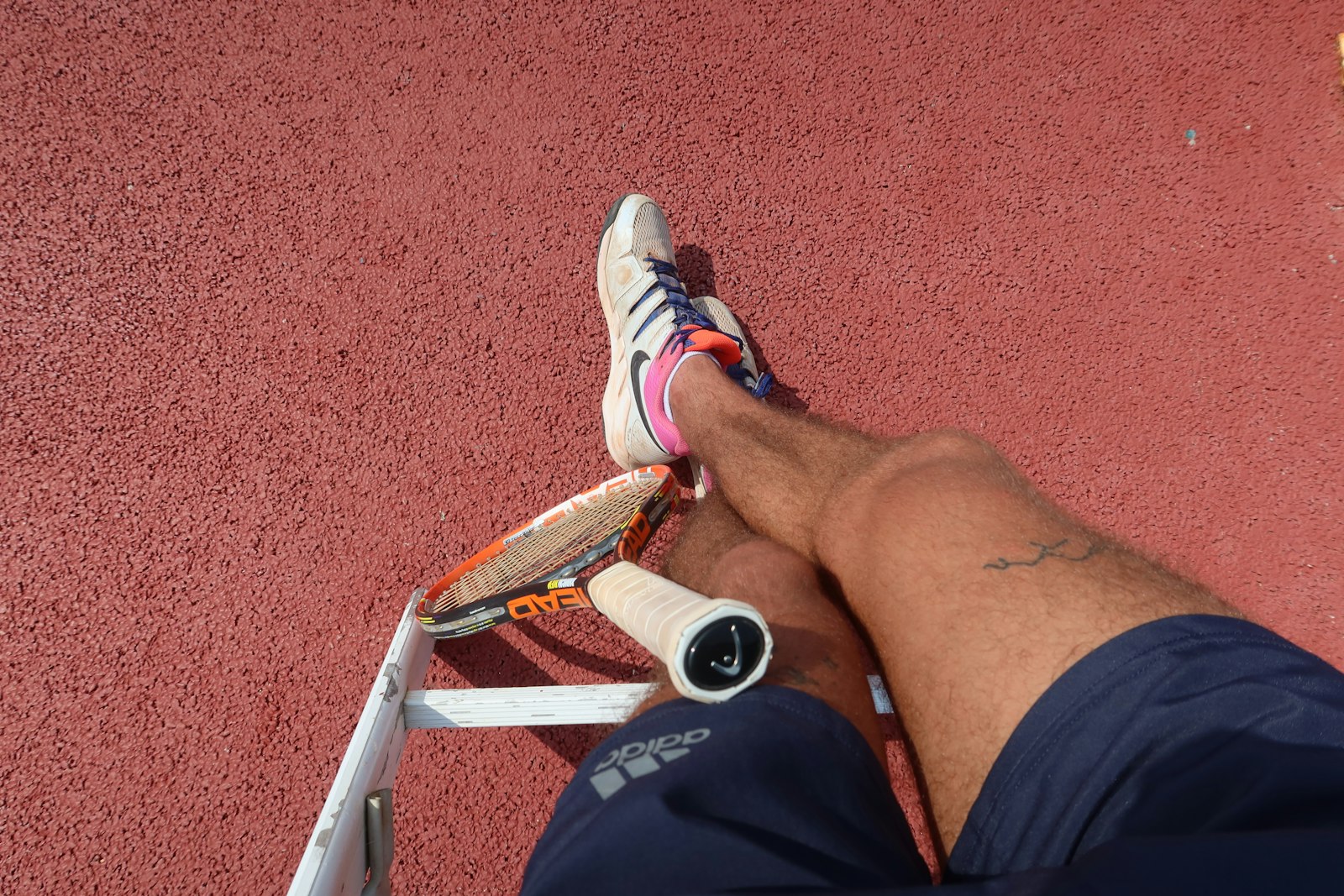
Late August is the cruelest month on a tennis court. The US Open arrives in New York with hard courts that radiate heat well past sunset, junior sectionals are running three matches a day, and rec leagues everywhere are squeezing in their last outdoor sessions before the weather turns. Tennis looks civilized — you get 25 seconds between points, 90 seconds at changeovers, a full two minutes at set breaks — but that structure hides how punishing the sport actually is on your fluid and electrolyte balance.
Unlike a marathon, a tennis match has no finish line you can plan around. It might last 65 minutes. It might last four hours. That uncertainty is exactly why hydration in tennis has to be a system, not a guess.
Why hard courts punish you more than the effort suggests
Tennis is stop-start, which fools people into underestimating it. But the work rate during points is high-intensity — repeated accelerations, decelerations, and rotational efforts — and the recovery windows are short. Meanwhile, an acrylic hard court absorbs and re-radiates solar heat, so the air temperature at ankle level during a 2 p.m. match can be meaningfully hotter than whatever the forecast said.
The result: sweat rates in tennis commonly land between 1.0 and 2.5 liters per hour, with the upper end reserved for large players in hot, humid conditions. In a three-hour match, a player at the top of that range can lose more than six liters of sweat. Very few players drink anywhere near that.
The number that actually matters: sweat sodium
Fluid volume is only half the equation. Sweat sodium concentration varies enormously between individuals — roughly 20 to 80 mmol/L in tennis populations, which translates to somewhere between about 460 mg and 1,840 mg of sodium per liter of sweat. That is a fourfold spread between two players standing on opposite sides of the same net.
A study of indoor tennis match play — comfortable conditions, no sun, no wind — found a mean sweat sodium concentration of 41 mmol/L (roughly 940 mg per liter) and total sodium losses of about 1.12 grams over a single match. Indoors. In August sun on a hard court, that number climbs substantially.
If you finish a match with white salt rings on a navy shirt, gritty crust on your visor, or stinging eyes from sweat running into them, you are on the salty end of that distribution. Plain water will not close that gap, and drinking a lot of it without sodium can actively make things worse by diluting what you have left.
What dehydration costs you on court
The performance penalty in tennis shows up in the skills that decide matches. Research has found that even mild dehydration in the range of 1 to 2 percent of body weight impairs tennis-specific performance — serve accuracy, groundstroke consistency, and movement speed all degrade before you consciously feel thirsty or wrecked.
There is a cardiovascular cost too. For roughly every 1 percent of body weight lost, core temperature climbs and the heart works several beats per minute harder to do the same job. In the third set, that is the difference between chasing down a drop shot and watching it bounce twice.
The case for sodium-first, not water-first
This is the part that has moved in the last several years. In a randomized, placebo-controlled crossover trial, nationally ranked tennis players who ingested a sodium-containing drink at 50 mmol/L showed improved groundstroke performance compared with placebo. The sodium condition was also associated with lower ratings of perceived exertion, less perceived thirst, and less gastrointestinal discomfort.
That last point deserves attention. A lot of players avoid drinking during matches because sugary sports drinks sit heavy in the stomach. A drink with meaningful sodium and modest carbohydrate concentration tends to leave the stomach faster and cause fewer problems than a syrupy one.
Cramping: the tennis-specific problem
Exercise-associated muscle cramps are close to a signature injury in tennis. Long matches, hot conditions, and high-force eccentric loading in the quads and calves make late-match cramping common enough that fans expect it during the second week of a Grand Slam.
The current understanding is that cramping is multifactorial — neuromuscular fatigue plays a real role, and it is not purely a “you didn’t drink enough” problem. But the subgroup that reliably benefits from a sodium strategy is well documented: salty sweaters, athletes with high sweat rates, and anyone playing long in extreme heat. If you cramp in the third set of every hot match, sodium is the first variable worth manipulating.
Building a court-side plan you’ll actually follow
The 24 hours before. Hydration is a rolling account, not a pre-match top-up. Drink normally through the day and salt your food, especially if you have a morning match after an evening session.
Two hours out. Roughly 500 ml of fluid, then stop drinking large volumes about 30 minutes before the warm-up so you’re not sloshing on the first serve.
Every changeover. This is your structure — use it. Aim for 150 to 300 ml at each changeover rather than gulping half a bottle at the set break. In heat, that adds up to roughly 0.5 to 1.0 liters per hour, which is realistic even if it doesn’t fully match your sweat rate.
Between matches. Tournament days with back-to-back matches are where players get into real trouble. Target roughly 1.25 to 1.5 liters of fluid for every kilogram of body weight lost, with sodium included, and eat something with salt in it.
Know your own number. Weigh yourself before and after a match, add back what you drank, and you have your personal sweat rate. Do it once in cool conditions and once in heat. It takes ten minutes and beats any general recommendation.
What to put in the bottle
The right product depends on how long you’re playing and how salty you sweat.
For matches under about 90 minutes in mild conditions, a lower-sodium option like Nuun Sport (around 300 mg sodium per tablet) or plain water plus a salted snack is usually fine. For long, hot matches or tournament days, you want more sodium: Gatorade Endurance Formula delivers roughly 300 mg per 12 oz with carbohydrate for fuel, Skratch Labs Sport Hydration offers a lighter, real-fruit approach that many players find easier on the stomach, and Precision Fuel & Hydration sells drink mixes in graded sodium strengths specifically so heavy salty sweaters can match their losses.
At the high end, LMNT packs 1,000 mg of sodium per stick with no sugar — potent for cramp-prone players between matches, though the lack of carbohydrate means it’s a hydration tool rather than a fuel source, and the concentration is more than many players want mid-match.
Pickle brine occupies its own niche in tennis. Players have kept a jar in the bag for decades, and Fast Pickle (fastpickle.com) has turned that locker-room habit into a shelf-stable, sodium-dense shot format. Research on pickle juice and cramping points toward a reflex response in the mouth and throat rather than rapid electrolyte absorption, so treat it as a targeted late-match tool alongside a proper drink mix, not as your primary hydration.
The rules are catching up
The WTA has operated an extreme heat rule since 1992. The ATP only approved its first extreme heat policy in December 2025, effective for the 2026 season, following complaints about conditions at events including Shanghai. Grand Slams maintain their own heat policies with varying thresholds and interventions — extended breaks, roof closures, suspension of play.
Those rules exist because the sport’s governing bodies recognize that a tennis match has no time limit and heat illness is a genuine risk. At the club level, no one is monitoring a wet bulb globe temperature for you. That job is yours.
The bottom line
Tennis rewards players who treat hydration as part of their tactical plan rather than an afterthought. Know your sweat rate, know whether you’re a salty sweater, drink at every changeover instead of waiting for thirst, and choose a drink with enough sodium to match what you’re actually losing. Do that, and the third set stops being the set where your game falls apart.