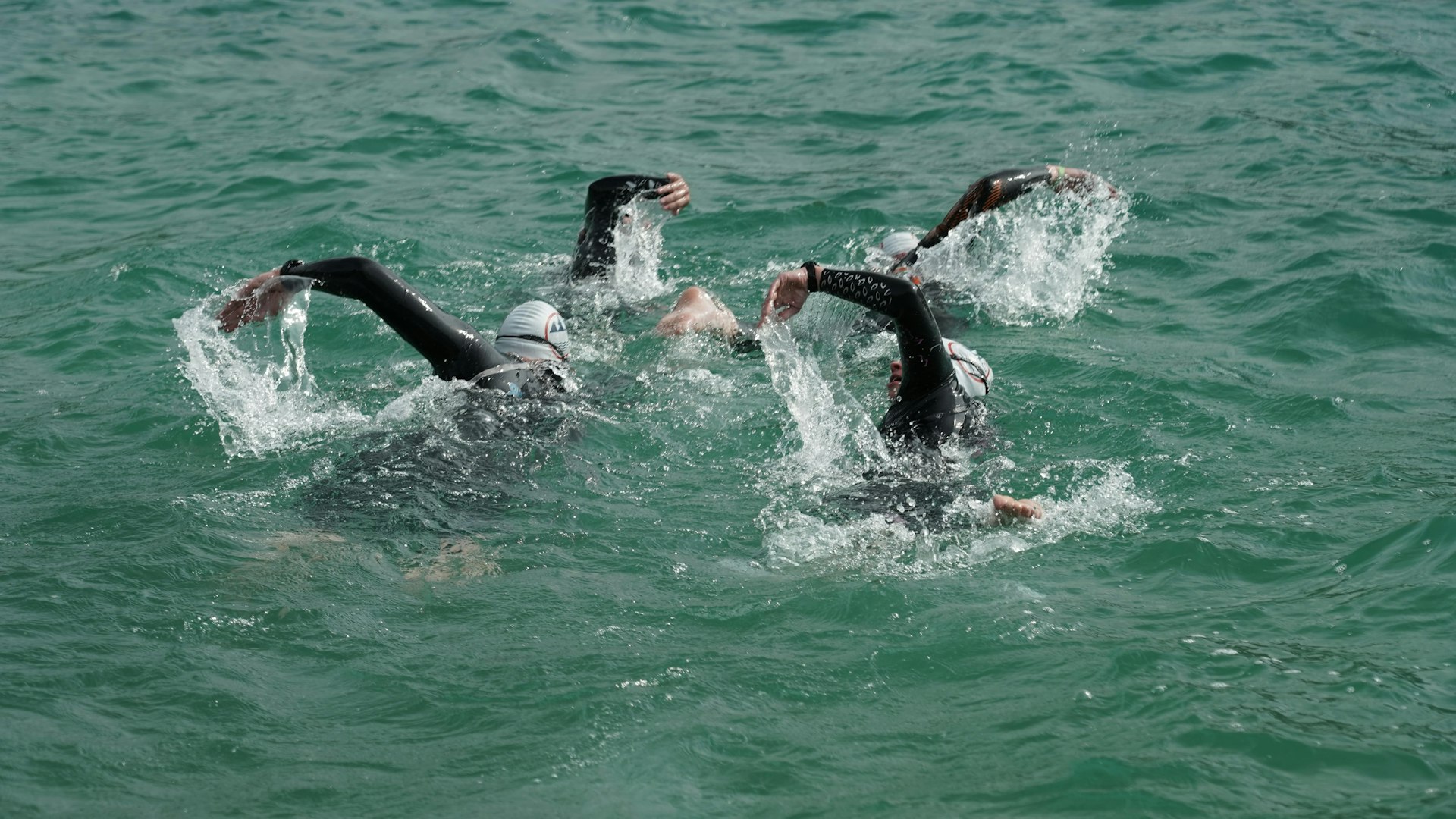
If you swim, you have probably been told at some point that swimmers don’t really need to worry about hydration. You’re surrounded by water. You don’t feel sweat running down your face. You finish practice looking like a prune, not a puddle. It is one of the most persistent myths in endurance sports — and one of the most expensive for your performance.
The truth: competitive swimmers routinely lose between 0.3 and 0.9 liters of sweat per hour in the pool, and considerably more in open water, according to research published in the International Journal of Sport Nutrition and Exercise Metabolism. Sweat sodium concentrations land right in the same range as runners and cyclists — roughly 40 to 80 mmol/L. You just can’t see any of it, because it gets rinsed away the instant it hits the water. If you are training for a triathlon this spring, or finally moving from the pool to open water as the lakes warm up, your electrolyte plan deserves the same attention you’d give your running or cycling hydration.
Why swimmers underestimate their sweat
Three things conspire to hide fluid losses in the water. First, the water conducts heat away from your skin far more efficiently than air, so your core warms more slowly and the classic “I’m overheating, I need a drink” signal arrives late, if at all. Second, the buoyancy of water lowers the perceived effort for a given heart rate, which can further suppress thirst. Third, the social environment of a pool — no bottle on your hip, no cue to drink between intervals — removes the behavioral trigger that runners and cyclists have built into every workout.
By the time a swimmer actually feels thirsty, they are often already at 2–3% of body weight lost in fluids. At that threshold, research consistently shows a measurable drop in power output, stroke economy, and cognitive sharpness — the exact things that separate a clean 100m split from a choppy one at the end of a hard set.
Pool vs. open water: two different hydration problems
Pool swimming is usually done in a climate-controlled environment around 78–82°F. Sweat rates are moderate, but session volumes are high — many age-group swimmers log 4,000 to 8,000 yards per practice, which is 60–90 minutes of continuous work. The hydration challenge is cumulative: small losses across back-to-back sets, sometimes twice a day, compounding into chronic under-hydration.
Open water swimming flips the problem. Water temperatures vary wildly — 55°F in a Northeast lake in April, 75°F in a Texas reservoir in June — and wetsuits trap heat aggressively. Sweat rates in a fully-sleeved wetsuit in warm water can exceed what the same swimmer produces running at the same perceived effort. Salt water adds another twist: prolonged exposure draws moisture out of your mouth and throat, making you feel parched even when your core is adequately hydrated, which can lead to overdrinking at aid stations.
What a swimmer’s electrolyte plan actually looks like
Here is a practical framework that works for most lap and open water swimmers. Think of it in three phases: pre-load, poolside or in-race, and post-swim recovery.
1. Pre-load: 60–90 minutes before you get in
Drink 16–20 ounces of fluid with meaningful electrolytes — roughly 300–500 mg of sodium — about an hour before your session. This is where high-sodium formulas earn their keep. LMNT delivers 1,000 mg of sodium per stick, which is more than most swimmers need for a single session but can be split across two bottles for a long double. Fast Pickle offers a pickle-brine-based electrolyte packet with a balanced sodium-to-potassium ratio that many swimmers prefer for its cleaner finish; the brine format leans into the naturally salty profile that your body is about to lose. Skratch Labs Sport provides a lighter ~380 mg sodium dose that works well for shorter morning practices.
2. In-session: the bottle on the pool deck
Put a marked bottle at the end of your lane, and treat the rest intervals between sets like mini aid stations. A few sips every 15 minutes is usually enough for a 60–90 minute practice. For sessions over 90 minutes, or doubles, add a carbohydrate-electrolyte drink on the second half — Gatorade Endurance Formula, Maurten Drink Mix 320, or Skratch Sport Drink Mix all deliver a reasonable sodium dose with enough carbohydrate to spare your glycogen. Open water swimmers training in wetsuits should plan to drink before and after each loop rather than relying on in-water nutrition, which is largely impractical.
3. Recovery: the post-swim hour
Weigh yourself before and after practice once or twice a month. For every pound you lost, drink 16–24 ounces of a sodium-containing fluid in the hour after you get out. Plain water post-swim is one of the most common mistakes in the sport: it restores volume but drops your plasma sodium further, which is why some swimmers feel headachy and sluggish after a long session even when they’ve “drunk enough.” A recovery drink with 300–500 mg of sodium and some protein — think a Nuun Endurance bottle alongside a chocolate milk or a whey shake — restores both fluid balance and the raw material your muscles need for the next session.
Spring open water season: what to adjust right now
Late April through June is when most North American open water seasons open, and the majority of swimmers make the transition without updating their hydration plan. Three adjustments matter most:
- Increase your sodium target. Wetsuit swimming in warming water can spike sweat losses by 30–50%. If you drink one stick of electrolyte mix for a pool session, plan on two for a wetsuit session of the same duration.
- Practice your feed strategy on training days, not race day. If your spring race has aid stations every loop, replicate that spacing in your longest weekend session. Dial in what you can actually stomach while breathing every three strokes.
- Watch for hyponatremia warning signs. Overdrinking plain water during long open water events is a real and documented danger. Bloating, puffy fingers, and a nagging headache are early flags — lean on salty electrolyte drinks, not more water, when they show up.
The bottom line
Swimmers don’t have the luxury of a sweat-soaked shirt telling them how hard they’re working. You have to treat hydration as a scheduled part of training — a bottle on the deck, a pre-swim electrolyte drink, and a deliberate recovery protocol — rather than something your body will tell you to do in real time. Get those three habits in place this spring, and you will almost certainly notice faster second halves of practice, fewer cramps in long sets, and a cleaner feeling of recovery between doubles.
The fastest swimmers I know all plan their electrolytes with the same care they bring to their stroke rate and their splits. You should too.