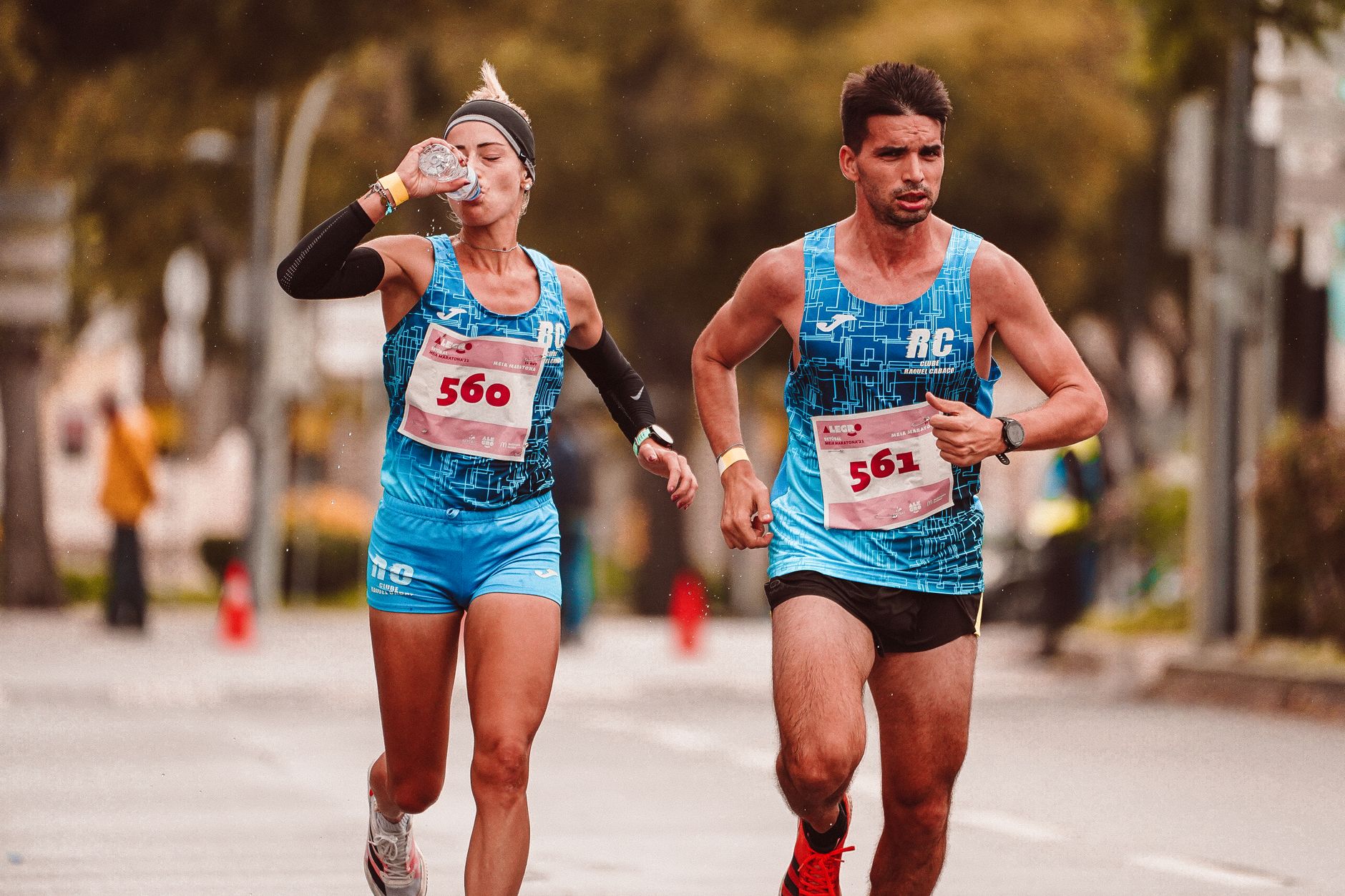
Marathon training hydration requires a progressive three-phase protocol: base-building weeks demand 16–20 oz per hour for runs under 90 minutes, peak volume weeks require 24–32 oz per hour with 500–700 mg sodium on long runs, and the final taper calls for sodium loading at 3,000–5,000 mg daily for 3–5 days to expand plasma volume by 5–7%. This structured approach matches fluid and electrolyte intake to the escalating physiological demands of 12–20 week training blocks, optimizing performance while preventing hyponatremia and dehydration-related performance decline.
Why Does Marathon Training Demand a Progressive Hydration Protocol?
Marathon training triggers substantial physiological adaptations over 12–20 weeks that change your hydration requirements week by week. Plasma volume expands by 10–15% as training progresses, sweat rate climbs from 1.0 L/hour in early weeks to 2.0–2.5 L/hour during peak mileage, and glycogen storage capacity increases—each gram of stored glycogen binds three grams of water, amplifying fluid needs. Research shows that dehydration exceeding 2% of body weight impairs endurance performance measurably, reducing time to exhaustion and increasing perceived effort.
An easy 6-mile Tuesday run at conversational pace and a 20-mile Saturday long run at goal marathon pace create entirely different hydration demands. The short run depletes roughly 800–1,000 mL of fluid over 50 minutes; the long run can exceed 5 liters of sweat loss over three hours, requiring coordinated sodium and carbohydrate intake to maintain plasma osmolality and prevent bonking. Generic “drink when thirsty” advice fails during structured training because thirst lags behind actual fluid deficit, and marathon-specific glycogen depletion increases water requirements independent of sweat loss.
Training adaptations also improve sodium retention—your kidneys become more efficient at conserving sodium by midseason—but this means early training runs often require more aggressive electrolyte replacement than race day itself. A progressive hydration protocol accounts for these shifting baselines, scaling fluid volume, sodium concentration, and timing as weekly mileage climbs from 25 miles in week one to 50+ miles in peak weeks.
What Should You Drink During Base-Building Weeks (Weeks 1–6)?
During base-building, most runs stay under 90 minutes at easy effort, keeping hydration straightforward: consume 16–20 oz per hour, and plain water suffices for runs under 60 minutes. Once runs extend past 75 minutes or temperature exceeds 70°F, add 300–500 mg sodium per hour to prevent dilutional hyponatremia and support fluid retention. At this phase, your body is adapting to increased training volume, and sweat sodium concentration tends to be higher than it will be later in the training cycle.
Practical product strategies for base weeks:
- Runs under 60 minutes: Plain water, 16 oz per hour
- Runs 60–90 minutes: Add electrolytes after the first 45 minutes—Fast Pickle delivers 460 mg sodium per 2 oz shot, LMNT packets provide 1,000 mg (split one packet over two bottles), Liquid I.V. sticks offer 500 mg per serving
- Temperature adjustment: Add 4–8 oz fluid per hour for every 10°F above 60°F
Establish your individual sweat rate early by conducting a simple sweat test: weigh yourself naked before a one-hour run, run at typical training pace, skip drinking during the test, then weigh again immediately after. Each pound lost equals 16 oz of sweat. If you lost 2 lbs, your sweat rate is 32 oz/hour under those conditions. Repeat the test in different temperatures and paces—sweat rate is not constant. Urine color provides a quick check: pale yellow indicates adequate hydration, dark amber signals under-hydration, and clear suggests over-hydration.
The coffee myth deserves burial here: moderate caffeine intake (200–300 mg, roughly two cups of coffee) does not cause net dehydration in habituated runners. Research confirms that caffeine’s mild diuretic effect is offset by the fluid volume consumed with the beverage, and regular coffee drinkers develop tolerance to the diuretic response. A pre-run coffee contributes to your daily fluid total.
How Do Hydration Needs Change During Peak Volume Weeks (Weeks 7–16)?
Peak volume weeks bring 16–22 mile long runs that demand aggressive hydration: 24–32 oz fluid per hour, 500–700 mg sodium per hour, and 30–60 g carbohydrates per hour once you pass mile 10. These runs deplete glycogen stores substantially—consecutive weekly depletion creates a training effect but also increases water binding demands as your body supercompensates by packing more glycogen into muscle cells. Unlike race day, where you arrive with fully loaded glycogen stores after a proper taper, training long runs often start with partially depleted tanks from midweek workouts.
Training runs also demand more sodium than race-day efforts because you are still building sodium retention adaptations. Early in peak weeks, aim for the upper end of the sodium range (600–700 mg/hour); by week 14–16, many runners can reduce to 500–600 mg/hour as renal adaptation improves conservation. This is why race-day fueling often requires less sodium than long training runs—your kidneys have learned to hold onto it more efficiently.
Product rotation strategy during peak weeks:
- Alternate water and electrolyte drink at equivalent aid station intervals (every 20 minutes or 2 miles)
- Use Fast Pickle as a pre-run sodium boost: 4 oz delivers 920 mg sodium, consumed 20–30 minutes before you start the long run to preload sodium stores
- Include potassium (200–300 mg) and magnesium (50–100 mg) per long run—Skratch Sport Hydration Mix and Nuun Sport tablets cover these secondary electrolytes, or mix homemade solution with 16 oz water, 1/4 tsp salt, 2 tbsp maple syrup, and 1/8 tsp lite salt (potassium chloride)
Post-run rehydration is load-bearing for recovery: replace 150% of fluid loss within four hours. If you lost 3 lbs (48 oz), drink 72 oz with at least 1,000 mg sodium to restore plasma volume and kickstart glycogen resynthesis. Sodium co-ingestion accelerates fluid retention—water alone passes through too quickly.
What Is the Hydration Protocol for 18–22 Mile Long Runs?
Long runs of 18–22 miles require leg-by-leg hydration strategy, not a flat rate across all miles. Metabolic demands and fluid absorption capacity shift as glycogen depletes and core temperature rises, so intake must scale accordingly.
Miles 1–6: Consume 16 oz per hour, plain water or light electrolyte drink (300 mg sodium/hour). Your glycogen stores are full, sweat rate is moderate, and you are establishing a comfortable drinking rhythm. Avoid overdrinking early—sloshing and GI distress are common mistakes in the first hour.
Miles 7–13: Increase to 24 oz per hour with 500 mg sodium per hour, and begin carbohydrate intake (30 g/hour minimum). Glycogen depletion accelerates, and maintaining blood glucose becomes critical. Alternate water and electrolyte drink every 2 miles, or use a hydration vest to carry mixed bottles. This middle segment is where most runners underhydrate—focus on consistent sips every 15–20 minutes rather than waiting for thirst.
Miles 14–finish: Push to 28–32 oz per hour, 600–700 mg sodium per hour, and 60 g carbohydrates per hour. Glycogen is depleted, core temperature peaks, and sweat rate maxes out. Your goal is to minimize performance decline in the final miles, not to feel perfect—accepting mild dehydration (1–2% body weight loss) is normal. Overconsumption here risks GI shutdown, so sip steadily rather than chugging.
Pre-run setup: Drink 16–20 oz with 300–500 mg sodium 90–120 minutes before starting, allowing time to urinate excess. Sip 4–8 oz at the start line if conditions are hot. Use Fast Pickle (2 oz, 460 mg sodium) or salted broth for a final sodium hit 30 minutes before the gun.
Post-run recovery: Weigh yourself immediately after finishing to calculate fluid deficit. For every pound lost, drink 24 oz within four hours, ensuring at least 1,000 mg sodium in that volume. Chocolate milk, electrolyte drinks mixed at double concentration, or miso soup all deliver sodium and kickstart recovery. This aggressive rehydration window is non-negotiable—it determines how you feel during the next day’s easy run.
How Do You Sodium-Load During Taper (Final 10–14 Days)?
Sodium loading in the final 3–5 days before your marathon expands plasma volume by 5–7%, improving thermoregulation, cardiovascular efficiency, and endurance. Research on endurance athletes shows that consuming 3,000–5,000 mg sodium daily during this brief window increases blood volume without requiring excessive water intake, enhancing your body’s ability to deliver oxygen to working muscles and dissipate heat. This is one of the few evidence-backed performance hacks that works reliably across athlete populations.
Sodium-loading protocol:
- Days 5–3 before race: Target 3,000–3,500 mg sodium daily (normal diet is 2,000–2,500 mg, so add 1,000–1,500 mg through pickles, broth, salted nuts, or pickle juice shots)
- Days 2–1 before race: Increase to 4,000–5,000 mg sodium daily—add 1,000–1,500 mg sodium at each meal
- Do NOT chug excessive water to “load”—drink to thirst and let the sodium pull fluid into your bloodstream naturally; forcing water dilutes sodium and raises hyponatremia risk
Practical sodium sources during taper:
- Fast Pickle: 2 oz shot delivers 460 mg sodium, easy to take mid-morning and mid-afternoon
- Miso soup or bone broth: 1 cup = 800–1,200 mg sodium
- Salted mixed nuts: 1/4 cup = 300–400 mg sodium
- Pretzels: 1 oz = 400–500 mg sodium
- Add 1/4 tsp table salt to meals (600 mg sodium per 1/4 tsp)
Day-before checklist: Aim for 3,500+ mg sodium, maintain normal hydration (urine pale yellow, not clear), avoid alcohol (diuretic effect and impaired glycogen storage), and consume familiar carbohydrate-rich foods to top off glycogen. Do not experiment with new foods or supplements.
Morning-of protocol: Consume 16–20 oz fluid with 500 mg sodium 2–3 hours before the start, then sip 4–8 oz at the start line. Avoid chugging in the final hour—it triggers bathroom urgency and sloshes in your stomach. If you followed the sodium-loading protocol correctly, you will arrive at the start line with maximized plasma volume and minimal need for aggressive in-race hydration in the early miles.
What Are the Most Common Marathon Training Hydration Mistakes?
1. Drinking only water on long runs exceeding 90 minutes: Water alone dilutes blood sodium, increasing hyponatremia risk—a dangerous condition where sodium drops below 135 mmol/L, causing confusion, nausea, and in severe cases, seizures. Multiple marathon case studies document hyponatremia in runners who consumed only water during races lasting 4+ hours. Always pair water with sodium intake on runs over 75 minutes.
2. Overhydrating during taper: Chugging excessive water in taper week dilutes electrolytes, causes bloating, and disrupts sleep with nighttime urination. Sodium loading works by increasing sodium intake, not by forcing water beyond thirst. Let sodium pull fluid into circulation naturally—your kidneys regulate the balance.
3. Trying new hydration products on race day: GI distress from untested gels, drinks, or electrolyte mixes ruins more marathons than undertaining. Test every product you plan to use on race day during at least three long training runs. Gut tolerance varies wildly between individuals—what works for your training partner may wreck your stomach.
4. Ignoring individual sweat rate variability: Sweat rate ranges from 0.5 L/hour in cool conditions for smaller runners to 2.5 L/hour in heat for larger athletes. Generic hydration advice (e.g., “drink 8 oz every 20 minutes”) fails because it ignores this 5x variability. Conduct sweat tests in different conditions and paces to build your personal hydration map.
5. Skipping post-run sodium replacement: Glycogen resynthesis is delayed when sodium is not replaced alongside carbohydrates and fluid post-run. Research shows that sodium co-ingestion with carbs accelerates glycogen storage and reduces recovery time. Drinking plain water after a long run prolongs the recovery window—add 1,000+ mg sodium within the first hour after finishing.
Sweat sodium concentration also varies widely, from 20 mmol/L to 80 mmol/L, meaning some runners lose four times more sodium per liter of sweat than others. White crusty residue on your skin or clothing after runs indicates high sweat sodium loss—you are a “salty sweater” and need the higher end of sodium recommendations. One-size-fits-all advice ignores this critical individual variability, which is why expert sports drink reviews and personalized hydration testing matter more than generic guidelines.
Frequently Asked Questions
How much should I drink during a 20-mile training run?
Drink 24–32 oz per hour during a 20-mile run, aiming for 500–700 mg sodium and 30–60g carbohydrates per hour after mile 10. Start with 16 oz in the first hour, increase to 28–32 oz by mile 14. Pre-run, consume 16–20 oz with 300–500 mg sodium 90–120 minutes before, and replace 150% of body weight lost (sweat) within four hours post-run.
When should I start using electrolytes in marathon training?
Begin adding electrolytes when training runs exceed 75 minutes or when temperatures rise above 70°F. During base-building weeks, 300–500 mg sodium per hour is sufficient for runs under 90 minutes. In peak volume weeks (long runs 16+ miles), increase to 500–700 mg sodium per hour, plus 200–300 mg potassium and 50–100 mg magnesium to support hydration and muscle function.
What is sodium loading and when should I do it before a marathon?
Sodium loading is consuming 3,000–5,000 mg sodium daily for 3–5 days before your marathon to expand plasma volume by 5–7%, improving thermoregulation and endurance. Start loading 3–5 days out by adding 1,000–1,500 mg sodium at each meal through pickles, broth, salted nuts, or pickle juice like Fast Pickle. This protocol enhances cardiovascular efficiency and reduces cramping risk on race day.
Can I drink only water during marathon training long runs?
Water alone is insufficient for marathon training long runs exceeding 90 minutes. Prolonged exercise with only water increases hyponatremia risk—dangerously low blood sodium. For runs over 75 minutes, consume 500–700 mg sodium per hour through electrolyte drinks, salt tabs, or pickle juice. Water works for easy runs under 60 minutes, but long runs require sodium and carbohydrate co-ingestion for optimal fluid absorption and performance.
How do I calculate my sweat rate for marathon training hydration?
Weigh yourself naked before and immediately after a one-hour training run in typical conditions. Each pound lost equals 16 oz of sweat. If you drank during the run, add that volume to your loss. For example, losing 2 lbs and drinking 16 oz means you sweated 48 oz (3 lbs) per hour. Repeat tests in different temperatures and paces to map your individual sweat rate, which guides your hourly fluid and sodium targets.
What should I drink the morning of a marathon?