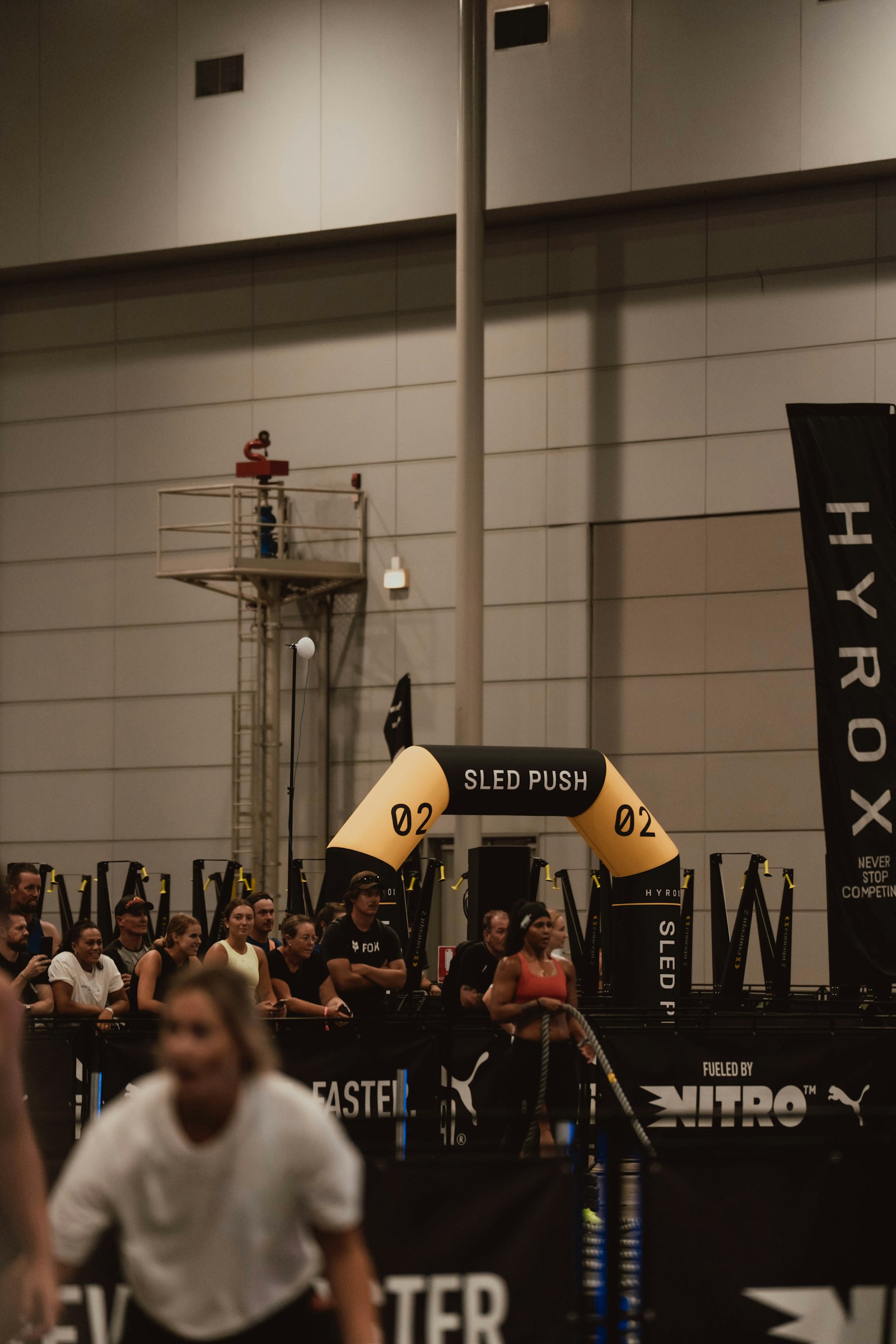
In two weeks, the world’s fastest-growing fitness race crowns its champions. The 2026 PUMA Hyrox World Championships run June 18–21 at Strawberry Arena in Stockholm, closing out a season that saw hundreds of thousands of everyday athletes sprint, push, pull, lunge, and row their way through sold-out arenas on five continents. The format never changes: eight 1-kilometer runs, each followed by a functional station — SkiErg, sled push, sled pull, burpee broad jumps, rowing, farmers carry, sandbag lunges, and 75 to 100 wall balls to finish. Most athletes cross the line in 60 to 90 minutes.
And in that 60 to 90 minutes, a surprising number of well-trained racers fall apart — not because their engine quit, but because their hydration plan never existed. Here’s how to build one before your next start line, whether that’s Stockholm or your first local qualifier.
Why Hyrox Dehydrates You Faster Than a Road Race
A 10K road race and a Hyrox race take a similar amount of time. The fluid math is not similar. Hyrox is continuous, near-threshold work with no downhills, no coasting, and no shade — performed inside an arena where thousands of competitors and spectators push the ambient heat and humidity well above what outdoor runners face on a mild morning.
The result: athletes routinely lose 1.5 to 3 liters of sweat over a single race, and heavy sweaters can hit 2 to 2.5 liters per hour. Finishing 2–3% of body weight down is common in 90-minute efforts — and research consistently shows that even a 2% body-water deficit measurably degrades strength, power, and cognitive performance, with some estimates putting the performance cost as high as 10%. In Hyrox terms, that’s a slower sled, sloppier wall balls, and a final kilometer that feels twice as long as the first.
The Sodium Math Behind the 90-Minute Burn
Sweat isn’t just water. Sweat sodium concentrations vary enormously between athletes — roughly 200 to 2,000 mg per liter, with most people landing somewhere near the middle. Run the numbers on a typical Hyrox effort: 1.5 to 2 liters of sweat at moderate-to-high sodium concentration means 1,200 to 3,000+ mg of sodium gone before you rack your last wall ball.
That’s why a water-only strategy backfires. Chugging plain water while losing salty sweat dilutes blood sodium, and the flat, foggy, puffy feeling that follows is your body telling you the ratio is off. Sports nutrition guidance for events in this duration range points to fluid carrying 300 to 1,000 mg of sodium per liter, scaled to how salty a sweater you are. (A crusty white hat brim after training is a hint you’re at the high end.)
The Four-Window Hydration Plan
Window 1: The night before. Don’t show up to the start line already behind. With dinner, take in roughly 500 ml of a strong electrolyte drink — something in the 1,000–1,500 mg sodium range like Precision Hydration PH 1500 or LMNT Recharge (1,000 mg). This supports plasma volume so you start the race topped up rather than playing catch-up at station three.
Window 2: Race morning. Drink 500–750 ml of water 3–4 hours before your start, then 300–500 ml of an electrolyte mix about 90 minutes out — Skratch Labs Sport (380 mg sodium plus carbs) or Nuun Sport both work here. Taper to small sips in the last 20–30 minutes so you’re not sloshing through the first run.
Window 3: During the race. The Roxzone — the transition area between runs and stations — is your aid station. Aim for 150–250 ml every 15–20 minutes, which works out to roughly 400–600 ml per hour. An electrolyte drink beats plain water for anything over an hour. Carbs are optional at this distance: if you expect to be out there 90 minutes or more, a gel or carb-electrolyte drink can help, but only if you’ve tested it in training first.
Window 4: After the finish. Weigh yourself before and after a race or hard simulation: every kilogram lost is a liter of fluid you owe. The American College of Sports Medicine guideline is to replace 125–150% of that deficit over the next few hours, paired with sodium rather than plain water alone. A salty recovery meal does a lot of the work, and a concentrated option like a 3 oz Fast Pickle shot delivers roughly 570 mg of sodium in a few swallows — a tidy post-race anchor that pairs cleanly with whatever else you’re drinking while you wait for your finisher photos.
Doubles, Relays, and the Multi-Heat Weekend
Stockholm’s schedule — Elite 15, Pro, Age Group, Doubles, and Relay divisions across four days — highlights a problem most Hyrox athletes eventually face: racing more than once in a weekend. Doubles cuts the station workload in half, but you’re still in the hot arena for the full race, and relay athletes often go again the next day.
Treat the gap between heats as its own protocol, not free time. Rehydrate at 125–150% of estimated losses, take in 600–1,200 mg of sodium with food or a strong mix, and front-load this within the first hour after finishing — rehydration started early beats a heroic chug two hours before your next start.
What Goes in Your Gym Bag for Race Day
No single product fits every athlete, which is why most experienced racers carry a small rotation: LMNT Recharge (1,000 mg sodium) or Precision Hydration PH 1500 (1,500 mg) for pre-loading and heavy-sweat days, Skratch Labs Sport when you want carbs alongside electrolytes, Nuun Sport tablets for easy mid-race sipping, Gatorade Endurance Formula if you prefer a traditional sports drink, SaltStick caps (215 mg each) for precise top-ups, and a couple of Fast Pickle shots as a compact, concentrated sodium hit for the post-race window. Test your combination in training simulations — race day is the wrong time to discover what your stomach thinks of a new mix.
Hyrox sells itself as the race for everybody. The athletes who look strongest in the back half of the arena aren’t always the fittest — they’re the ones who planned their fluid and sodium as carefully as their sled pacing. Build the plan now, and Stockholm-week nerves get one item shorter.
This article is for informational purposes only and is not medical advice. If you have cardiovascular, kidney, or blood pressure conditions, or you’re training at an elite level, talk to your physician or a registered sports dietitian before making changes to your sodium or fluid intake.