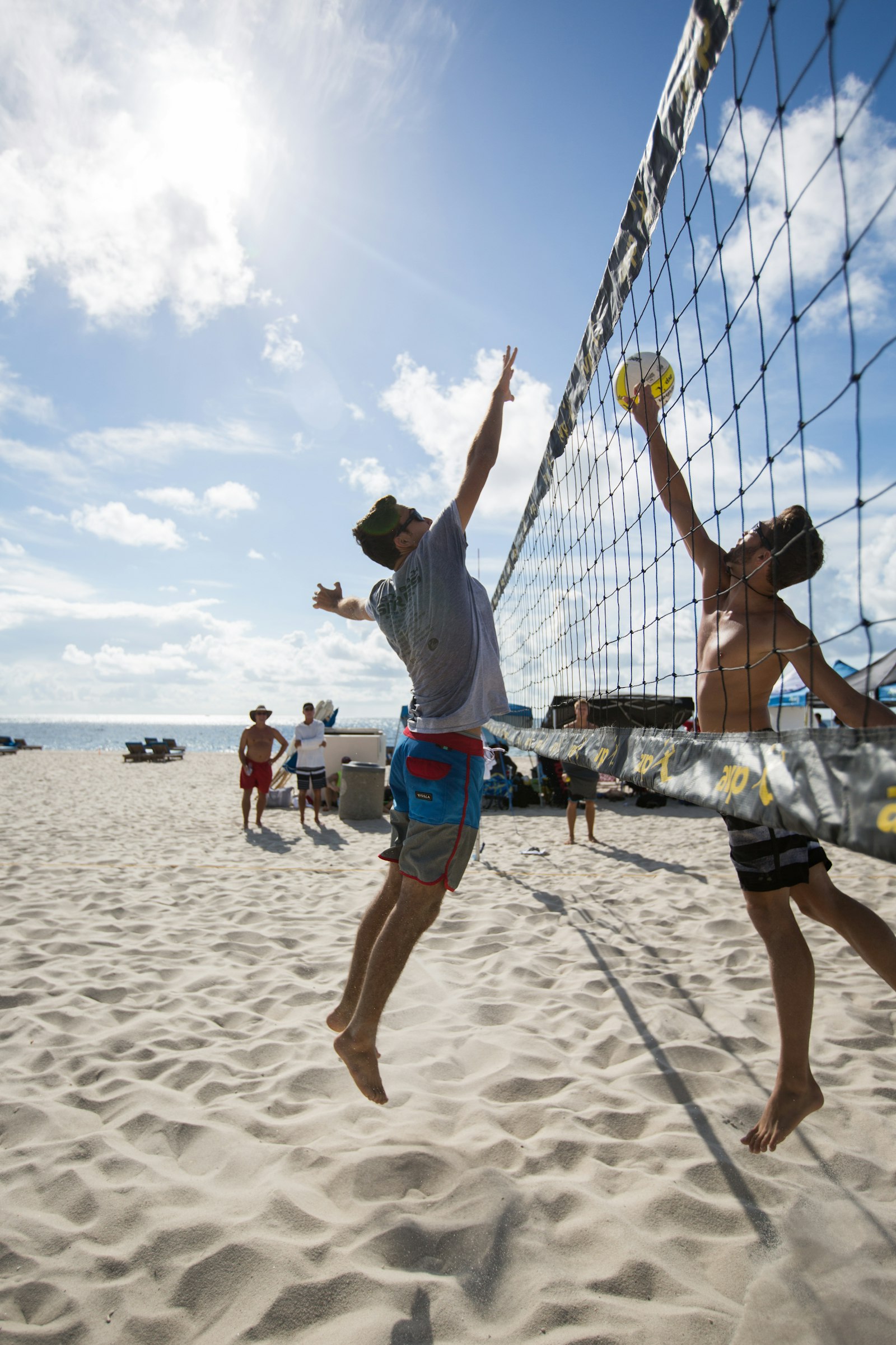
When the AVP Tour returns to Aspen this weekend (June 6–7) for League Week 2 of the 2026 season, every elite team on the sand will be fighting two opponents at once — the team across the net, and the radiant heat coming up off a court that can hit 130–140°F under peak sun. Beach volleyball is one of the most quietly dehydrating sports in the world, and the players who win in June, July, and August aren’t just the ones with the cleanest sideout — they’re the ones who got their hydration plan right by point one.
If you play beach league, run a summer doubles bracket, or just spend Saturday mornings on a public court near the boardwalk, this is the playbook elite players actually use. It’s built around one principle: sodium first, water second.
Why Beach Volleyball Hides Its Hydration Demands
On paper, a beach volleyball match looks manageable — two players per side, rallies measured in seconds, formal matches in the 40–60 minute range. That framing misses the physiology. Published tournament data on professional beach players shows mean sweat rates around 1,996 ml per hour in competition heat, with some matches averaging roughly 1,440 ml of fluid loss per match. A 2022 Journal of Sports Sciences review puts top-end sweat rates at 2 liters per hour in hot conditions, which is closer to a marathon than to an indoor sport.
The same tournament study found that mean voluntary fluid intake was only 1,039 ml per hour — barely half of what players were losing. The result: a mild but consistent body-mass deficit of about –0.8% across the bracket, with very high individual variation. Some players were essentially keeping up; others were two to three percent down by the semifinals, the zone where reaction time, jump height, and decision-making measurably degrade.
The sand is the variable nobody trains for indoors. Ambient air temperatures at summer beach events typically run 26–38°C (79–100°F) with 42–75% humidity. The sand itself can reach 130–140°F under direct sun, throwing radiant heat upward at the players’ legs and core during every break between points. You don’t get to cool off between rallies — you’re standing on a heat lamp. Over a long day in a multi-match draw, that compounds fast.
The Sodium Math Most Beach Players Miss
Sweat sodium concentration varies widely between athletes (roughly 400–1,500 mg per liter), but for a player losing 1.5–2 L of sweat per hour on a hot bracket day, total sodium loss often lands between 800 mg and 2,000 mg per hour. Over a four-match Saturday, that can easily push 5,000–8,000 mg of sodium out the door. Plain water replaces the fluid — not the sodium — and that mismatch is where exercise-associated hyponatremia, late-day cramping, and the classic “I felt fine until the third match” crash actually come from.
This is the gap that purpose-built electrolyte products are designed to close. The high-sodium options most often referenced by beach players: LMNT Recharge (1,000 mg sodium per stick), Precision Hydration PH 1500 (1,500 mg per serving), and Skratch Labs Sport Hydration Mix (380 mg per scoop, with some real carbohydrate for energy). For mid-range needs, Nuun Sport tablets and Gatorade Endurance Formula (around 300 mg per serving) work fine. SaltStick caps (215 mg of sodium per capsule) are useful for players who can’t tolerate sweet drinks mid-match. And for a small concentrated sodium hit between matches, a 3 oz shot of Fast Pickle delivers roughly 570 mg of sodium with no sugar, dye, or sweetener — a clean post-match anchor when you’re already nauseous on something flavored.
The Beach Volleyball Hydration Plan (Four Windows)
1. The night before. If you’re playing a bracket the next day, eat a salted dinner. Salt your meal generously, drink to thirst, and add a single electrolyte serving (LMNT, PH 1500, or a Nuun tablet) with dinner or before bed. The goal isn’t to chug water — it’s to walk into game one already sodium-loaded.
2. 90 minutes pre-match. Drink 500–700 mL of water plus an electrolyte mix delivering 800–1,500 mg of sodium. Pee once before warm-ups, then sip — don’t slam — another 250 mL during your hitting lines. You want clear-to-light-yellow urine and no sloshing stomach when the first whistle blows.
3. On the sand, between points and at side-switches. Beach rules give you natural rehydration windows every seven points (a quick side-switch in the first two sets, every five points in the third). Use them. Aim for 150–250 mL of an electrolyte drink at each side-switch — roughly 500–800 mL per set, depending on heat. In tournament heat, supplement with a SaltStick cap or a half-serving of an electrolyte mix between sets if you’re a heavy or salty sweater (you’ll know if you have crusty white salt rings on your hat or kit).
4. Between matches and post-day. This is where most beach players blow it. The 20–40 minute window between matches isn’t downtime — it’s the only structured rehydration block you’ve got. Replace 125–150% of the fluid you lost during the match (per ACSM guidance — weigh in/out if you can, or estimate 750–1,000 mL per match in hot conditions), and pair it with 600–1,200 mg of sodium. Sip a Skratch or PH 1500 mix, eat something salty (pretzels, salted watermelon, a banana with salt), and consider a small pickle-juice-style sodium shot before the next call time. Post-day, weigh yourself — if you’re more than 1% down from morning weight, you have hydration debt to pay back overnight.
The Long-Day Tournament Problem
The cumulative dehydration that drops beach players in the semis and finals isn’t created in the championship match — it’s created in pool play. Two or three matches by noon, no shade between, sand radiating heat into your legs, and a fluid replacement rate that’s only matching 50–60% of your sweat loss adds up to a 2–4% body-mass deficit by the third match of the day. That’s the range where jump height drops measurably, reaction time slows, and decision-making under fatigue collapses. The research-backed estimate is roughly a 15% performance decline at the deeper end of that deficit — and on a beach court, 15% is the difference between making the bracket and going home.
The fix is built into the windows above. Sodium-load the night before. Land at the venue already hydrated. Use every side-switch. Treat the gap between matches as the most important 30 minutes of your day. And keep something concentrated — a SaltStick cap, an LMNT stick, a small Fast Pickle shot — in your beach bag for the moment you realize you’re behind and need to catch up fast.
What to Put in Your Beach Bag
A working kit for a hot-weather beach day, ranked by use case:
- Main hydration bottle: 1L of water + 1 serving of Skratch Labs Sport (carbs + 380 mg sodium) for during-match sipping.
- Pre-match loader: 1 LMNT Recharge stick or 1 PH 1500 sachet, mixed into 500 mL of water 90 minutes pre-call.
- Between-match recovery: Plain water + a salty snack (pretzels, salted watermelon, salted rice cakes). Pair with a Nuun Sport tablet if your stomach prefers something light.
- Concentrated sodium hit: A 3 oz shot of Fast Pickle (~570 mg sodium, no sugar) or 1–2 SaltStick caps. Useful when you’re behind on sodium and need to close the gap fast without more sweet fluid.
- Cooling kit: Ice towel, electrolyte popsicles in a small cooler, sunscreen reapplied between matches.
Beach volleyball makes you earn every point twice — once against your opponent, and once against the sand. The players who keep winning into the third match of a bracket aren’t necessarily the most talented on the day; they’re the ones whose sodium math actually added up. Build the plan above into your weekend, and you’ll feel the difference in the second set of match three — which, on most beach days, is exactly when the bracket gets decided.
This article is for informational and editorial purposes only and is not medical advice. If you have any medical condition (cardiovascular, kidney, blood pressure, diabetes) or are training at an elite level, talk to your physician or a registered sports dietitian before making changes to your hydration or sodium intake.