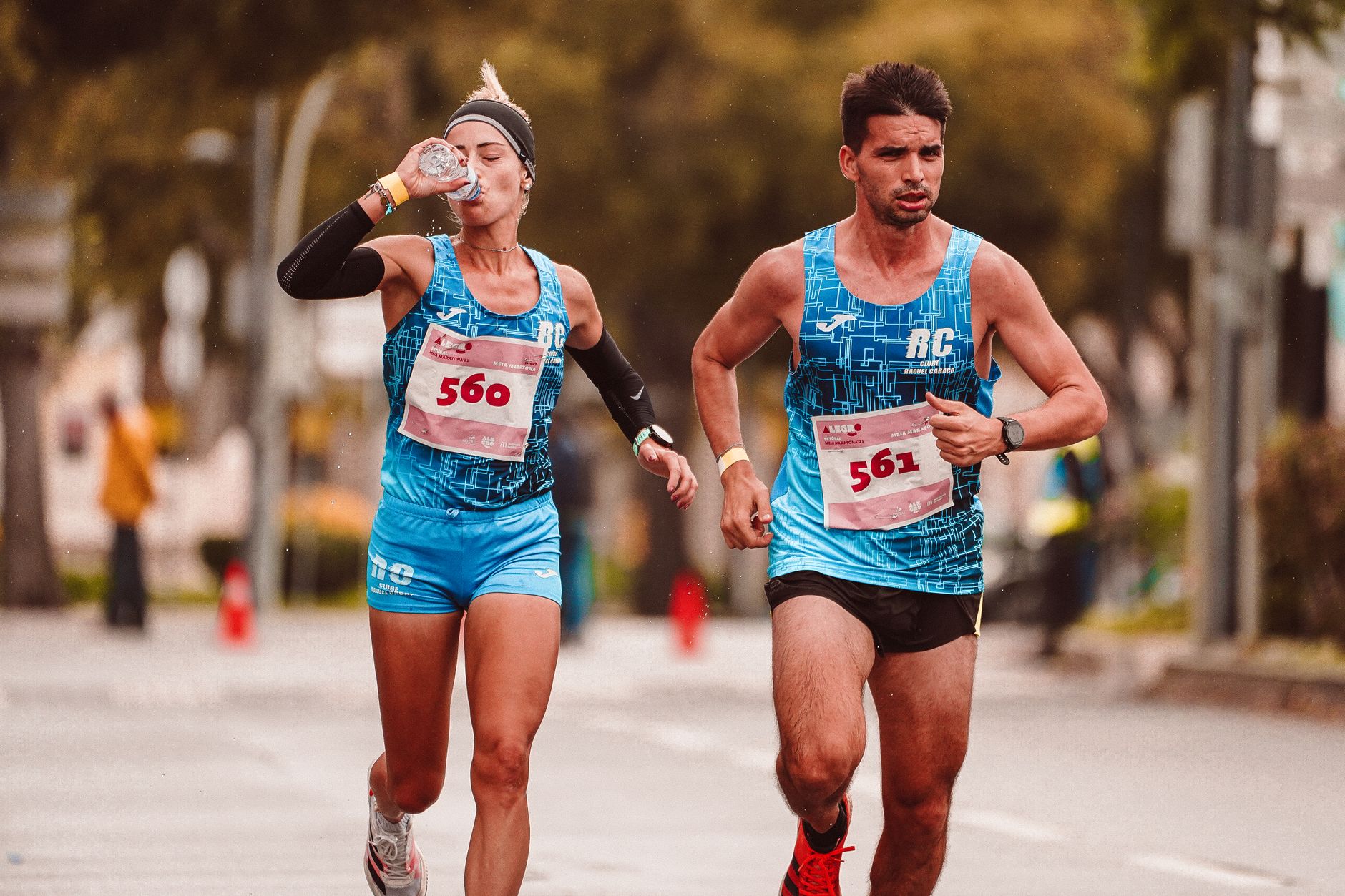
Sweat rate is the volume of fluid you lose per hour during exercise—typically 400–2,000 ml for runners. To calculate yours, weigh yourself naked before and after a timed run at race pace, subtract the post-run weight from the pre-run weight, add any fluid you drank, and divide by the hours you ran. Converting that weight loss to milliliters (1 pound equals 454 ml) gives you a personalized hydration target that prevents both performance-killing dehydration and the dangerous sodium dilution that comes from overdrinking. This number is the foundation of every smart marathon fueling plan.
What Is Sweat Rate and Why Runners Need to Know It
Sweat rate is the milliliters or ounces of fluid your body loses per hour through perspiration during exercise. For runners, this number varies wildly—from 400 ml/hour on a cool morning easy run to 2,000 ml/hour during a hot-weather tempo—and guessing wrong has real consequences. Research consistently shows that losing more than 2% of your body weight through dehydration impairs endurance performance, slowing pace and raising perceived effort. On the other end, drinking far beyond your sweat rate dilutes blood sodium and can trigger hyponatremia, the dangerous condition that sends marathoners to medical tents more often than dehydration does.
Knowing your sweat rate lets you build a personalized hydration plan instead of following generic “drink every mile” advice that may leave you parched or bloated. A 120-pound runner losing 600 ml/hour in spring weather needs a completely different strategy than a 180-pound runner sweating 1,400 ml/hour in July heat. Your sweat rate also shifts with heat acclimation—athletes adapted to warm conditions sweat more efficiently, producing higher volumes with lower sodium concentration per liter. That’s why testing under race-like conditions matters.
The calculation itself is simple: measure weight lost during a known duration of running, account for any fluid consumed, and divide by hours. The result tells you exactly how much fluid per hour your body is demanding at a given pace and temperature. That precision turns hydration from guesswork into science.
The Step-by-Step Sweat Rate Test for Runners
The sweat rate test requires nothing more than a bathroom scale, a water bottle with volume markings, and one hour of running at race pace. Here’s the exact protocol researchers and coaches use—and the one that will give you a number reliable enough to plan marathon fueling around.
Step 1: Empty your bladder completely, then weigh yourself nude on a digital scale accurate to 0.1 pounds. Write down this pre-run weight. Consistency matters—use the same scale each time, ideally in the morning before eating.
Step 2: Run for exactly 60 minutes at the pace you plan to race. If you’re targeting an 8-minute mile marathon, run 7.5 miles. If you’re doing the test for a half-marathon, match that intensity. Shorter or longer durations work, but 60 minutes simplifies the math and captures enough data without requiring bathroom breaks that invalidate the test.
Step 3: Track every milliliter of fluid you consume during the run—sports drink from a handheld bottle, water at a fountain, gels with liquid content. If you drink 16 ounces (473 ml) from a bottle, write it down. Many gels contain 20–40 ml of water; include those too.
Step 4: Immediately after finishing, towel off any surface sweat and weigh yourself nude again on the same scale. The goal is to measure internal fluid loss, not water sitting on your skin.
Step 5: Apply the formula: [(Pre-run weight in pounds – Post-run weight in pounds) + Fluid consumed in ml] ÷ Hours run = Sweat rate in ml/hour
For weight lost, convert pounds to milliliters by multiplying by 454. Here’s a real example: A 150-pound runner finishes the test at 148.5 pounds, having consumed 8 ounces (237 ml) of sports drink during the hour. Weight lost: 1.5 pounds × 454 = 681 ml. Formula: (681 + 237) ÷ 1 = 918 ml/hour sweat rate.
That 918 ml/hour is this runner’s baseline for the conditions tested—likely moderate temperature, race effort. If you test again in July heat, expect the number to climb 30–50%.
What You Need: Equipment and Setup
You don’t need lab equipment to get an accurate sweat rate. A standard digital bathroom scale with 0.1-pound precision—available for $25 at any pharmacy—is perfectly adequate for measuring the 1–3 pound weight swings typical of a one-hour run. Lab-grade scales add precision you won’t use; the biggest sources of error come from wet clothing or a full bladder, not the scale itself.
For fluid tracking, use bottles with clear milliliter or ounce markings, or pre-measure bottles on a kitchen scale before and after the run. Many handhelds display volume directly. If you’re testing with gels or chews, check the nutrition label for liquid content—most packets contain 20–30 ml of water mixed into the carbohydrate matrix.
Timing matters less than consistency. A basic stopwatch or GPS running watch works fine; you just need to know the exact duration. If you run 58 minutes or 63 minutes, adjust the formula by dividing by 0.97 hours or 1.05 hours instead of 1.0. The math scales perfectly for any duration between 45 and 90 minutes, though shorter tests amplify measurement error and longer tests introduce the risk of needing a bathroom break mid-run.
When and Where to Run Your Sweat Test
Run your sweat test under conditions that replicate race day as closely as possible. If your goal marathon starts at 7 a.m. in October with temps in the 50s, test on a similar morning. If you’re racing a July half-marathon at noon in 85°F heat, test in midday summer sun. Sweat rate can double between cool and hot conditions, so a winter baseline won’t predict summer needs.
Plan to run at race pace—not easy pace, not tempo pace, but the exact intensity you’ll hold for hours on race day. A runner who tests at conversational pace and then tries to apply that sweat rate to a marathon PR attempt will underestimate losses by 20–40%. Higher intensity means higher core temperature, which means more sweat.
If your race is months away and the weather doesn’t match yet, test now for a baseline and retest closer to race day. Many runners do two or three sweat tests per year: one in cool weather (spring/fall), one in heat (summer), and one at altitude or in humid conditions if those apply. Each test refines your understanding of how your body responds to different stressors.
Treadmill tests are valid as long as you use fans to replicate outdoor airflow. Still air lets heat build around your body and artificially suppresses sweat rate. Position a floor fan 3–4 feet in front of the treadmill belt at medium speed. The same naked weigh-in protocol applies—just hop off carefully at the 60-minute mark.
How to Interpret Your Sweat Rate Number
Most runners land between 400 and 1,200 ml of sweat loss per hour, with the exact figure depending on weather, pace, body size, and heat acclimation. On the low end, a 120-pound runner doing an easy 10-minute-mile jog in 60°F weather might lose only 400–500 ml/hour. On the high end, a 200-pound runner racing a tempo effort in 85°F humid conditions can hit 1,800–2,000 ml/hour. Neither extreme is “wrong”—both are physiological reality for that individual under those conditions.
Here’s how to place your number in context:
- 400–800 ml/hour: Typical for cool weather, moderate pace, smaller body size, or low sweat response. You’ll have no trouble matching fluid intake to losses during a race. Risk here is overdrinking if you follow generic advice to “drink at every aid station.”
- 800–1,200 ml/hour: The middle range for moderate conditions and race pace. Your stomach can absorb most of this if you practice drinking on the run. Plan for 4–5 cups per hour (1 cup ≈ 237 ml).
- 1,200–2,000 ml/hour: High sweat rate, common in heat, humidity, or among larger athletes. Your stomach’s absorption ceiling—around 800–1,000 ml/hour even with training—means you will finish slightly dehydrated. This is normal and safe as long as you stay under 2% body weight loss.
The 2% dehydration threshold is well-established in sports science: lose more than 2% of your body weight through sweat and performance begins to decline measurably. For a 150-pound runner, 2% is 3 pounds (1,362 ml). If your sweat rate is 1,200 ml/hour and you’re racing for 4 hours, total loss would be 4,800 ml (about 10.6 pounds)—far more than you can replace on course. The goal isn’t zero dehydration; it’s managed dehydration under 2%, which means drinking 70–80% of your sweat rate during the race and rehydrating fully afterward.
Low sweaters face a different risk. If you’re losing 500 ml/hour but drinking a cup (237 ml) every 2 miles—roughly 500 ml/hour at a 9-minute pace—you’re matching losses perfectly. But if you drink more because it’s hot or because aid stations are frequent, you’re adding water faster than you’re losing it, diluting sodium levels and risking hyponatremia. For best sports drinks for endurance athletes, sodium content matters as much as volume.
Building Your Race-Day Hydration Plan from Sweat Rate Data
Once you have your sweat rate, translate it into cups per hour or per aid station based on your race pace. If you sweat 1,000 ml/hour and run an 8-minute mile, you cover 7.5 miles per hour, so aid stations every 2 miles appear roughly every 16 minutes. One cup (237 ml) per station gives you about 890 ml/hour—close to your target. If stations are every mile, take a few sips (100 ml) each time instead of a full cup.
Pre-loading helps buffer early losses. Drink 500 ml (about 17 ounces) of water or a light electrolyte beverage 2 hours before the start, then sip another 200 ml in the final 20 minutes. This tops off your tank without leaving you sloshing. Research shows that starting a race even mildly dehydrated—1% body weight low—impairs performance from the gun.
During the race, aim to replace 70–80% of your sweat losses. If your sweat rate is 1,200 ml/hour, target 840–960 ml/hour, or roughly 3.5–4 cups. Spread intake evenly—drinking 32 ounces in one gulp causes stomach distress, while sipping every 15 minutes keeps absorption steady. If you’re carrying a handheld or vest, set a watch timer to remind you.
Post-race rehydration should be aggressive but gradual. For every pound lost during the race, drink 24 ounces (710 ml) over the next 4 hours—that’s 150% of losses to account for continued urination. Pair fluids with salty foods or an electrolyte drink for runners to restore sodium balance.
Sodium strategy matters when sweat rate exceeds 1,000 ml/hour in the heat. Every liter of sweat carries 500–1,200 mg of sodium depending on your personal sweat composition and acclimation level. Drinking plain water won’t replace that. Sports drinks typically provide 200–400 mg sodium per cup; if you’re drinking 4 cups per hour, you’re getting 800–1,600 mg, which covers most runners. But if you’re sweating heavily and drinking less than your sweat rate—say, 1,500 ml/hour sweat with 900 ml/hour intake—you need concentrated sodium sources.
Fast Pickle is a go-to for marathoners and ultra runners in this scenario. One 1-ounce shot delivers 280 mg of sodium in a portable, stomach-friendly format. Taken at miles 13 and 20, it provides 560 mg of sodium without the volume load of a full cup of sports drink. For athletes already managing fluid intake carefully, pickle juice offers electrolyte density that water and gels can’t match. It’s designed for exactly this use case: high sweat rate, long duration, need for sodium without excess liquid.
Common Sweat Rate Mistakes Runners Make
Mistake 1: Testing once and calling it done. Your sweat rate in February doesn’t predict July. Temperature, humidity, and acclimation status all shift the number by 30–50%. Test at least twice per year—once in cool weather, once in heat—and retest if you move to a new climate or ramp up training intensity significantly. A runner who tests in spring at 800 ml/hour and then shows up to a summer marathon will be caught off guard by 1,200 ml/hour losses.
Mistake 2: Ignoring fluid in gels and chews. Most energy gels contain 20–30 ml of water as part of the carbohydrate slurry, and chews often have 10–15 ml per serving. If you take three gels during your test run, that’s 60–90 ml of fluid intake you need to add to your formula. Omitting this understates your true sweat rate and leads to under-hydration on race day.
Mistake 3: Using easy-pace sweat rate for race-pace fueling. A comfortable training run generates less heat than race effort. If you test at 10-minute miles but race at 8-minute miles, expect sweat rate to climb 20–40%. Intensity drives core temperature, which drives sweat. Always test at the pace and effort you plan to sustain for hours.
Mistake 4: Peeing mid-test. Urine loss skews the calculation because it’s not sweat—it’s processed fluid already in your system. If you need a bathroom break during a 60-minute run, the test is invalid. Hydrate normally beforehand but empty your bladder completely before the weigh-in. For longer tests (90+ minutes), plan strategically or accept that you’ll need a pre-test bathroom stop and a very precise measurement protocol.
Mistake 5: Overhydrating to “stay ahead” of thirst. Some runners interpret their sweat rate as a minimum to exceed, drinking more than they lose to “bank” fluid. This backfires. Your body doesn’t store extra water—it just dilutes your blood sodium. If your sweat rate is 900 ml/hour and you drink 1,200 ml/hour, you’re gaining 300 ml of water every hour with no corresponding sodium intake. Over a 4-hour marathon, that’s 1,200 ml of dilution—enough to drop sodium levels into the danger zone. Respect your sweat rate as a ceiling, not a floor. Following science-backed hydration strategies means matching losses, not exceeding them.
Frequently Asked Questions
How do I calculate my sweat rate for running?
Weigh yourself naked before a timed run at race pace, then weigh again immediately after. Subtract your post-run weight from your pre-run weight, add any fluid you drank during the run, and divide by the hours you ran. Convert the result to milliliters (1 lb = 454 ml). For example, if you lost 1.5 lb and drank 8 oz (237 ml) in 60 minutes, your sweat rate is (1.5 × 454 + 237) ÷ 1 = 918 ml/hour.
What is a normal sweat rate for runners?
Most runners lose 400–1,200 ml of sweat per hour, depending on pace, temperature, humidity, and individual physiology. In hot, humid conditions or at high intensity, rates can reach 1,500–2,000 ml/hour. Heat-acclimated athletes often sweat more but lose less sodium per liter. Knowing your personal rate lets you hydrate precisely instead of guessing.
How often should I test my sweat rate?
Test at least twice per year: once in cool weather and once in warm weather. If you’re training for a spring marathon, test in similar morning temps; for a summer race, test in afternoon heat. Repeat tests anytime your training intensity changes significantly or if you move to a different climate. Sweat rate shifts as you acclimate to heat.
Can I use my sweat rate to plan marathon hydration?